Hillside settling cracks
Diagonal cracks off door and window corners and seams that split along the ceiling line, cut out, taped and refinished.
Settling crack repair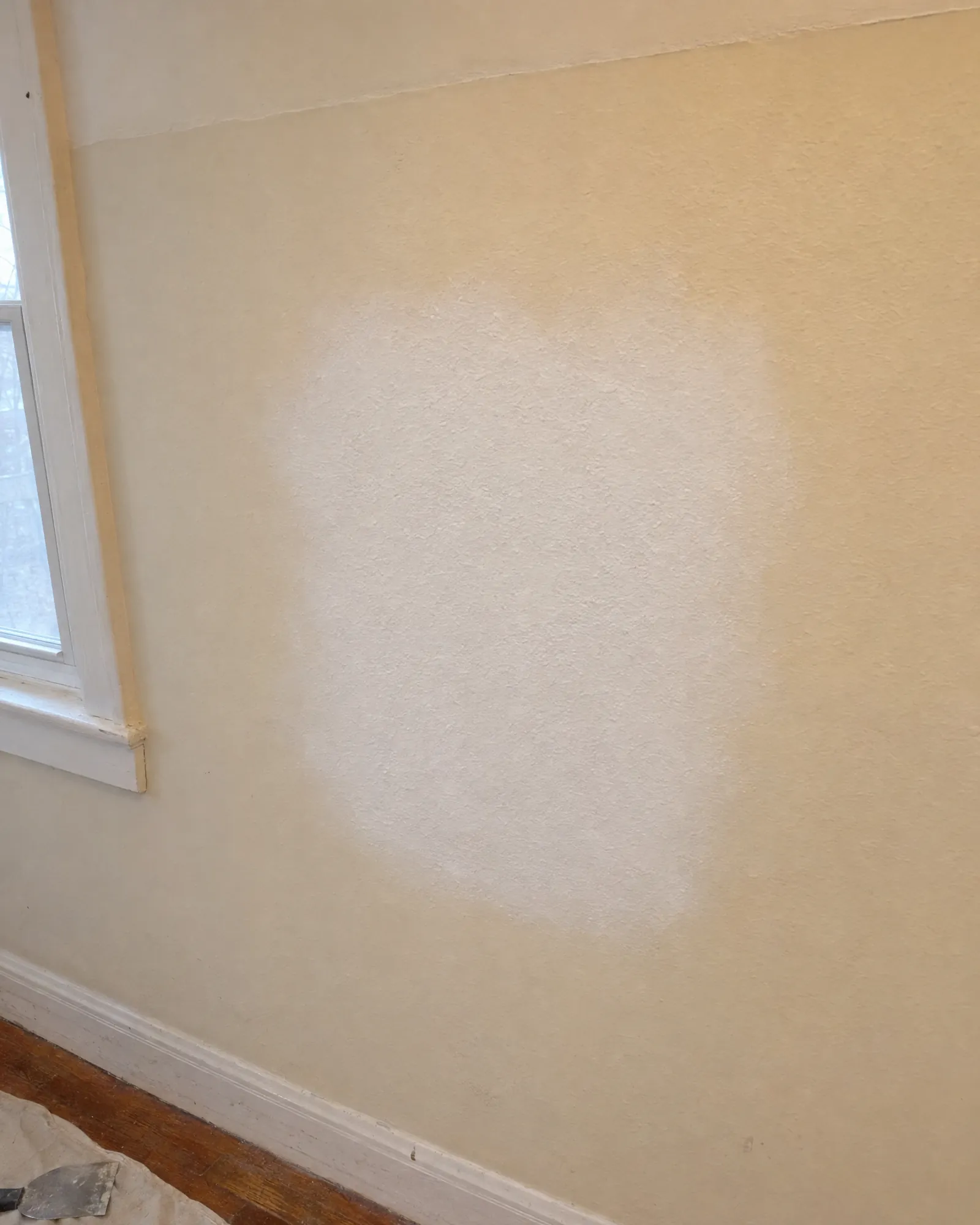
Walls and ceilings in a borough built mostly after the war
Doorway cracks from settling, plaster that has let go of its lath, ceiling stains from an old leak and holes cut by other trades, repaired and textured so the patch is gone once you paint.
Call (412) 796-2848Tell us what cracked, leaked or got knocked through, and a local drywall pro will ring you back to arrange a visit and quote the work before anything is touched.
Call 7 days, 7am–9pm
Most houses in West Mifflin went up before central air, a second bathroom or a ceiling light in every bedroom was ordinary, so the electricians, plumbers and heating installers who bring them up to date usually have to open a wall or ceiling to reach their work. Once that work is finished, and inspected where the job calls for it, the hole they leave behind is the part we close.
Fishing new circuits through plaster tends to leave a line of small square openings near the top of a wall and beside outlets. Each one gets wood backing behind its edges, a snug fill of board or setting compound, and tape across the joints so the outline does not ghost through the paint.
A cut made to reach a supply line or a shower valve is usually bigger and rougher. It is squared up, given cleats so the replacement board lands level with the wall, and closed with moisture-resistant board in a bathroom. If the plumber may need to get back in, a removable access panel is the better choice.
New supply and return registers for central air leave openings that rarely match the grille. The opening is shrunk with backing and board until the grille covers a clean, square edge.
Doorbell, speaker and camera wiring leaves a scatter of small holes and drilled notches. They are simple fills, but each still needs two thin coats and a touch of texture before it disappears.
When you get in touch, mention which trade was in and whether they plan to come back, so the wall is closed once rather than twice.
Each of these has its own page covering causes, the repair, and common worries before booking.
Diagonal cracks off door and window corners and seams that split along the ceiling line, cut out, taped and refinished.
Settling crack repairLoose, bulging or crumbling plaster in older houses, fastened back to the lath where it can be saved and rebuilt where it cannot.
Patching old plasterRings and brown blooms from roof, tub or radiator leaks, sealed so they stay gone, with soft board cut out and replaced.
Water-stained ceilingsFinished basement walls hit by seepage or a burst line, flood-cut, dried and rebuilt with board suited to rooms below grade.
Basement wall repairDoorknob dents, anchor tear-outs and cuts from electricians and plumbers, backed, patched and textured to match the wall.
Hole and dent patchingMifflin Township dates back to 1788, but the borough of West Mifflin was only formed in the 1940s, and the Census Bureau's American Community Survey shows how the housing followed: of roughly 8,970 homes, about 3,230 were built in the 1950s alone, more than in any other decade, and about 1,200 date from 1939 or earlier.
Those older houses are where real plaster still lives. Pre-war rooms were usually plastered over wood lath, and many houses of the 1940s and 1950s used gypsum lath boards under a thinner coat; both behave differently from drywall, cracking in long runs and losing their grip on the lath when water or movement has worked at them. A plaster patch has to be built up to the same thickness and hardness as the wall around it, or it shows later as a shallow dip or a soft spot.
Paint is the other thing age brings. The EPA notes that houses dating from before 1978 are more likely to contain lead-based paint, and that repair work which disturbs old painted surfaces can create a lot of lead dust. Around 86 percent of the borough's housing was built before 1980, so on older walls ask about lead-safe practices before any sanding begins, and keep children and pets out of the room while it happens.
Joint-compound dust drifts down hallways and gets pulled into furnace returns, so the room is closed off before the first cut or the first pass of sandpaper, and a good repair is judged as much by the rest of the house as by the wall itself.
Canvas or plastic runs from the doorway to the work area, and furniture is pulled into the center of the room or carried out, then covered. Clearing shelves, frames and lamps ahead of time saves a slow start.
Supply and return grilles in the room are taped over, and the furnace fan is left off during sanding so the dust is not carried through the ductwork to every other room.
A plastic sheet with a zip door, or a taped curtain, keeps the mess in one room, and the floor is vacuumed rather than swept once the sanding is done.
Vacuum-attached sanders and wet sponging cut the airborne dust sharply. On old paint that may contain lead, dry sanding should be avoided altogether.
Plan on the room being out of use while compound dries between coats; for most repairs that is a matter of days, not weeks.
The borough's Wikipedia entry records that its landscape was reshaped by the historic dumping of steel-mill byproducts such as slag and fly ash, and that developers filled ravines to make level lots. Filled ground that settles over time is one ordinary reason a house develops cracks at the corners of its doors and windows.
Kennywood opened at the end of the 1890s as a trolley park on a bluff above the Monongahela that had been part of Anthony Kenny's farm. NeighborhoodScout describes many homes in the surrounding Homeville area as built between 1940 and 1969, with some older still, which is plaster and early-drywall country: expect several layers of paint and older patches under the one you can see.
Allegheny County Airport was dedicated in 1931, and its terminal, with its Art Deco details, was built on a former steel-industry slag dump. Much of the borough's flat ground was made the same way, and on any filled or regraded lot a crack that is wider at the top of a door frame than at the bottom usually means the frame itself has shifted, not just the paint.
Century III Mall opened in 1979 on a slag heap locally called Brown's Dump; it closed in 2019 and its demolition was finished in 2026. The site is a reminder of how much level land here was built rather than found, and of why a crack that reopens after patching needs its cause understood before another coat goes on.
Fewer than one West Mifflin home in seven was built in 1980 or later, according to the same Census survey, and those houses from the 1980s, 1990s and 2000s are almost always drywall over wood framing rather than plaster. Their trouble shows up in different places.
Lumber that dries over the first few heating seasons shrinks away from the fasteners, and that pushes small round pops through the paint in a neat line along a stud. A pop is fixed by driving a new screw just beside it, setting the old nail below the surface, and covering both with two thin coats.
Roof trusses that rise slightly in winter can open a crack where an interior wall meets the ceiling, then close it again by summer. Refilling that crack just reopens it next winter; the lasting fix is to refasten the ceiling edge so it can flex, or to cover the joint with a trim that rides with it.
A ring from a roof leak, ice at the eave or an upstairs bath comes back through ordinary latex paint. After the leak is stopped and the board has dried out solid, it gets a stain blocker, shellac or oil base, before the ceiling is painted.
Water and failed fasteners let drywall droop between joists, and plaster ceilings sag when the keys that hold them to the lath break. A sag over a bed or a stairway should not wait for spring.
Sprayed acoustic texture was a common ceiling finish for decades after the war. Patching into it means matching the texture with a hopper or spray; scraping older popcorn should wait until a sample is tested, since some older acoustic textures were made with asbestos.
A ceiling seam that cracks again and again usually has tape that has come loose from the board. It is cut back, retaped in setting compound and feathered wide enough that the light from a window cannot pick it out.
For leak damage in particular, the page on repairing ceiling water stains walks through finding the source and deciding between sealing and replacing.
Munhall borders West Mifflin to the north, with Homestead just past it on the river; Duquesne lies east and Dravosburg southeast, ringed on its land side by West Mifflin itself. Baldwin is to the west with Whitehall beyond it, Pleasant Hills and Jefferson Hills sit to the south, and McKeesport is across the Monongahela by the Mansfield bridge.
Every town on the list of nearby towns we cover gets a line about its houses.
Plenty of wall damage really is a weekend job with a tub of compound, a six-inch knife and some patience, and it makes sense to try those first. The line is usually where the cause is still active, where the wall is plaster, or where the patch has to disappear into texture.
The wall and ceiling guides for local homes go through what each season does to a house here, and the page on how a repair gets arranged covers who comes out and when the price is settled.
Ring, or text a photo, with where the damage is, how big it is, when it started and whether the wall is plaster or drywall if you know.
A local pro comes to see it, works out the cause, and gives you a quote before any work starts.
The damage is cut back, backed and patched, then built up in coats with drying time in between.
The texture is blended in and the patch spot-primed, so the wall is ready for your paint or your painter.
Nail pops, anchor holes and dents up to a few inches. Two or three thin coats, little drying time, and often one visit with a second short stop to prime.
Holes up to about a foot, door-corner cracks and plumbing cuts. Backing, a new piece of board, tape and three coats, so expect drying overnight and at least two visits.
Ceiling sections after a leak, failed plaster across a wall, flood-cut basement walls. New board or a full skim coat, several coats, texture over a wide area and usually repainting the whole wall or ceiling plane.
For a sense of scale, Bob Vila's drywall repair guide puts fixing several holes and cracks in one room at roughly $200 to $550, and cites Fixr for a minimum of about $75 for a small hole up to 4 inches across. These are nationwide numbers rather than West Mifflin prices. What moves a quote here is access (stairwell ceilings and high walls), plaster versus drywall, texture matching, how many separate spots there are, and whether a leak or loose framing has to be dealt with first.
Call or message a picture of the crack, stain or hole. A short note on when it appeared and what room it is in helps the pro who comes out bring what the job needs.
Call (412) 796-2848Tell us what cracked, leaked or got knocked through, and a local drywall pro will ring you back to arrange a visit and quote the work before anything is touched.
Message a pictureCall 7 days, 7am–9pm
Sending this lets the pro on your wall ring your phone or text about it. How your details are handled
What happens next: a pro who mends walls in this part of the valley phones to arrange a visit and go over the price with you.